
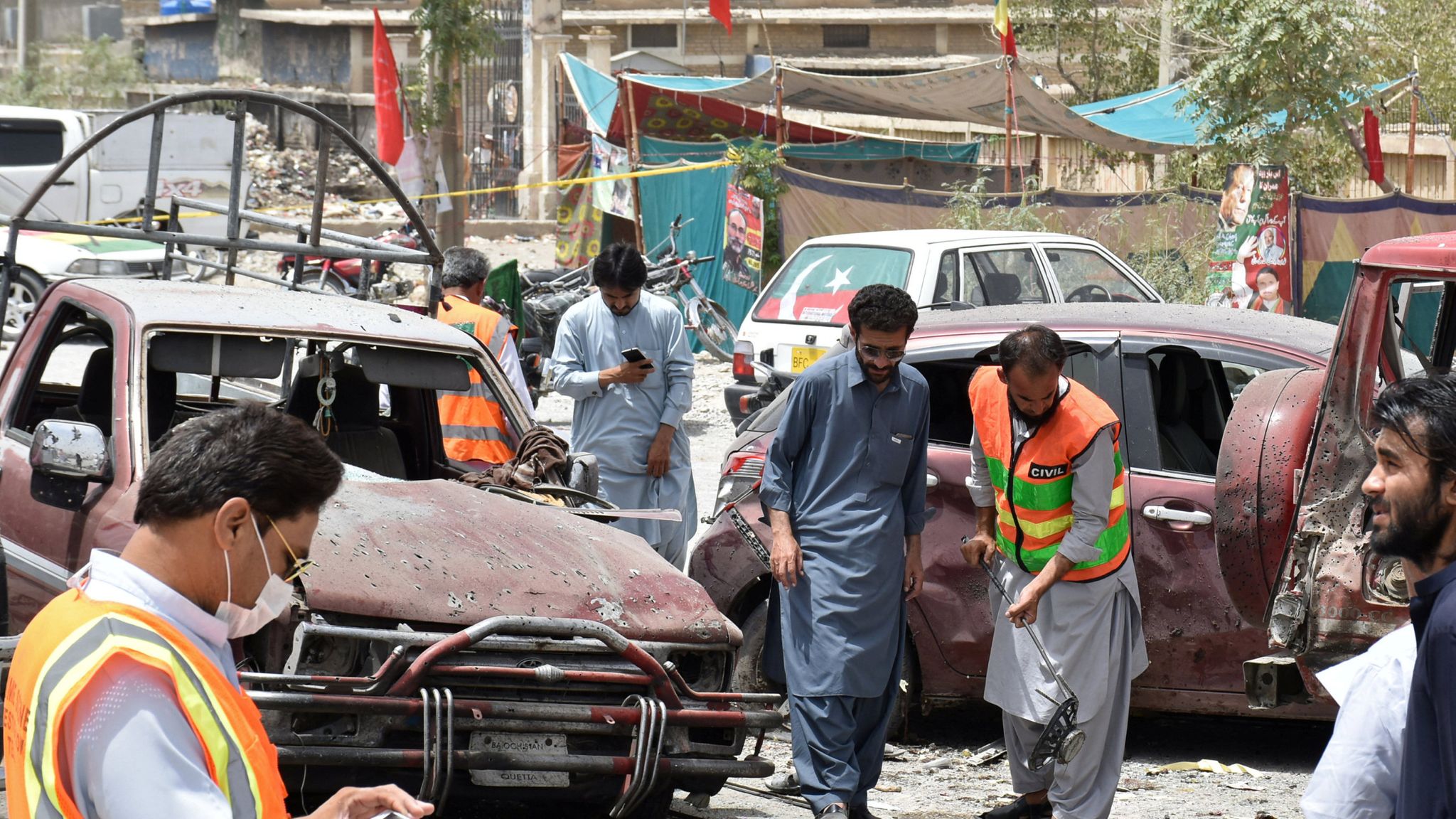
A blast at the Quetta railway station in Pakistan's Balochistan province has claimed the lives of at least 16 people and injured 30 others. The explosion occurred at a platform where a train was about to depart for Peshawar. Initial reports suggest it could be a suicide blast, but an investigation is underway to determine the exact nature of the incident. The Balochistan government has condemned the attack and launched a probe, with the Chief Minister vowing to eradicate terrorism from the province.
Quetta Railway Explosion: At Least 16 Killed in Balochistan Incident
Background:
On October 15, 2022, a powerful blast ripped through Quetta railway station in Pakistan's restive Balochistan province. The explosion, which occurred on a platform where a train was about to leave for Peshawar, claimed the lives of at least 16 people and injured over 30.
Details of the Incident:
Initial reports suggest that the blast may have been caused by a suicide bomber who targeted the crowded platform. Witnesses reported seeing a man with a backpack walking towards the train before the explosion. Security forces quickly cordoned off the area and launched a search operation.
Investigation and Response:
The Balochistan government immediately condemned the attack and announced a thorough investigation. Chief Minister Mir Abdul Quddus Bizenjo vowed to eradicate terrorism from the province. Law enforcement agencies have deployed additional personnel to enhance security in Quetta and surrounding areas.
Top 5 FAQs and Answers:
1. What is the cause of the blast?
Initial reports suggest it could have been a suicide blast, but an official investigation is ongoing to determine the exact cause.
2. How many casualties have been reported?
At least 16 people have been killed and over 30 injured, according to official reports.
3. Has any group claimed responsibility?
No group has yet claimed responsibility for the attack.
4. What are the security measures in place?
Security forces have been deployed to secure the area and prevent further incidents. Additional security measures are also being implemented in Quetta and neighboring regions.
5. What is the history of violence in Balochistan?
Balochistan has been plagued by violence and unrest for decades, with separatist groups demanding independence from Pakistan. Terrorist organizations also operate in the province, targeting security forces and civilians.
Conclusion:
The Quetta railway explosion is a tragic reminder of the ongoing security challenges faced by Pakistan, particularly in Balochistan. The government has vowed to bring the perpetrators to justice and eradicate terrorism from the province. It is crucial that all stakeholders cooperate to address the root causes of violence and ensure the safety and security of the people of Balochistan.

President Donald Trump is meeting with leaders of five Central Asian countries to discuss their vast reserves of rare earth metals, while also addressing a key point of friction in ongoing trade negotiations with China. The meeting comes on the heels of Trump's talks with Chinese leader Xi Jinping, where China agreed to delay their new export restrictions on rare earth elements. The U.S. is now seeking new ways to secure critical minerals, and the region is hoping for investment to develop their resources further.

US President Donald Trump has expressed concern over the tone of incoming New York City Mayor-elect Zohran Mamdani's victory speech, calling it "angry" and advising him to adopt a more cooperative approach. In response, Mamdani has urged Trump to "turn the volume up" and vowed to hold "bad landlords" accountable, citing Trump as an example. Trump has hinted at offering limited federal help to New York under Mamdani's leadership, but has also expressed doubt towards the mayor-elect's left-leaning policies. This clash between the two leaders marks a tense beginning to their relationship.

Chief Election Commissioner Gyanesh Kumar flagged off 14 participants from 7 countries as part of the International Election Visitors’ Programme 2025 to witness voting in the Phase-I of the Bihar Assembly Elections. The participants attended an inaugural session and were provided with a demonstration of the EVMs and a presentation on various aspects of elections in India. The participants will then embark on a two-day tour of Bihar to visit EVM dispatch centers and witness the actual polling on November 6. Since 2014, the IEVP has been showcasing the strengths of India's electoral system and sharing best practices with international election management bodies. The first phase of the Bihar Assembly elections, featuring 121 constituencies and over 3 crore voters, will be held on November 6.

The recent police raid in Brazil, which resulted in one of the deadliest operations in Rio's history, has sparked outrage and protests. Families of the victims claimed that their loved ones were executed by the police, while the government celebrates it as a win against crime. Shocking images of bodies lined up in the street have led to widespread protests and accusations of police brutality. However, official reports and videos of victims' bodies suggest that the deaths were not a result of armed conflict, raising questions about the excessive use of force by the police.

Four people have died and 11 have been injured after a UPS cargo plane crashed near Louisville Muhammad Ali International Airport in Kentucky. All flights in and out of the airport have been suspended as police and emergency services are attending the scene. Kentucky governor Andy Beshear has described the accident as "catastrophic" and is urging residents to obey any shelter-in-place orders.

Eight people have been killed and numerous others injured after a passenger train collided with a goods train in Chhattisgarh. The accident occurred in the afternoon, halting train services on the route and prompting the cancellation or diversion of multiple trains. Emergency teams have been dispatched to the scene, with rescue operations ongoing and medical treatment being provided to the injured passengers. Helpline numbers have been issued for convenience, and the railway authorities have assured that all efforts are being made to assist those affected by the tragedy.

Today, 5 November 2025, marks the 556th birth anniversary of Guru Nanak Dev Ji, the founder of Sikhism. As we celebrate this sacred and highly revered festival, let us remember and spread the teachings of Guru Nanak Dev Ji, which promote compassion, humility, and love for all. To commemorate this occasion, indianexpress.com has compiled heartfelt wishes and messages to share with friends and family, wishing everyone endless happiness, peace, and prosperity.

During the Emerging Science Technology and Innovation Conclave, PM Modi announced the launch of the Rs 1 lakh crore Research, Development and Innovation Fund. This fund, under the Department of Science and Technology, aims to encourage private sector investments in R&D to drive India's vision of becoming an innovation-driven nation. With this fund, India's R&D expenditure has doubled in the last decade and the country now has the world's third-largest startup ecosystem. PM Modi also highlighted how India's domestic capability has accelerated during the COVID-19 pandemic due to its successful digital public infrastructure.

A stampede at the Kasibugga Venkateswara Swamy Temple in Andhra Pradesh has left 10 dead and two injured. The temple had recently reopened and was experiencing high footfall due to a festival. Home Minister Vangalapudi Anitha has ordered a thorough investigation into the causes of the tragedy and has promised strict measures to prevent similar incidents in the future.

India and the United States have strengthened their already strong ties by signing a 10-year framework for their major defense partnership. The agreement, signed during a bilateral meeting between the two countries' defense ministers, emphasizes the importance of this partnership in maintaining a free and open Indo-Pacific region. This marks a significant step in solidifying the bond between India and the US in the defense sector.